
Spotify and AI Persona: When Transparency Risks Becoming a Label
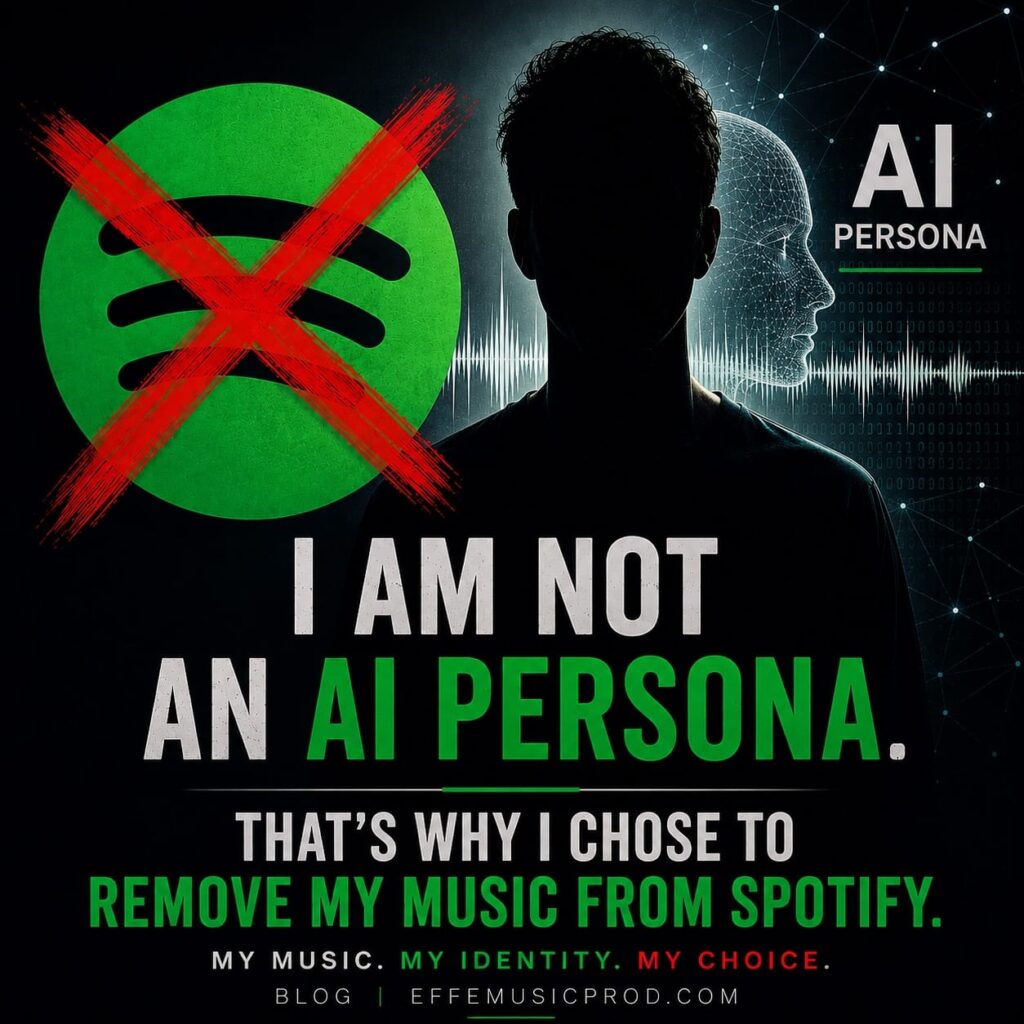
Artificial intelligence is a tool. But when a label appears, there is a risk that the public may start confusing the tool with the artist.
Spotify has decided to introduce a new indication for so-called AI Personas, with the aim of making the presence of artistic identities entirely generated by artificial intelligence more transparent.
The intention, in principle, is understandable.
In a musical landscape where it is now possible to create a virtual character, a voice, a face, a biography and even an apparently complete music catalogue in just a few minutes, knowing who or what is actually behind a project can be important.
Transparency is therefore a positive thing.
But there is a question I ask myself as an independent producer:
when does a label created to provide clarity risk becoming a label in the public’s perception?
And this is where I think the discussion becomes interesting.
I use artificial intelligence to improve photos and text.
Let me start with something I have no problem admitting.
Yes, I use AI.
I mainly use it for visual work: to create photomontages, improve the quality of an image, correct certain elements, work on the expressiveness of a face, create specific environments or, when needed, add graphic elements and text.
And I don’t see any problem with that.
In fact, for an independent producer, technology is often a necessity.
When you don’t have the budget of a major record company, you have to find solutions and make do with what you have.
You have to learn, experiment.
You have to become a producer, arranger, graphic designer, photographer, videomaker, web designer, social media manager, press officer and, sometimes, even the person who takes out the rubbish.
Why shouldn’t I use a tool that helps me?
This is the question I ask myself.
If artificial intelligence allows me to improve a photograph, why shouldn’t I use it?
If I can correct a flaw without having to organise a new photo shoot, why should I spend money?
If I can make a face more expressive, improve the quality of an image or create a more effective cover, why should I consider this use of technology any less legitimate than Photoshop, photo-editing software or any other digital tool?
Technology also serves this purpose:
putting tools into the hands of people with fewer resources that were once accessible only to those with large budgets.
It is a real opportunity.
But let’s be clear: using AI does not mean being an AI Persona
Here, in my opinion, we need to make a fundamental distinction. One thing is a project in which the artist themselves is an artificial identity, a nonexistent face, a character created artificially and presented to the public as if they were a real person.
Another thing is a real artist who uses artificial intelligence tools as part of their creative process.
These are two completely different situations. In the first case, we are talking about the very identity of the project, while in the second, we are talking about a tool.
And in my opinion, this distinction needs to remain absolutely clear, because otherwise we risk making a rather curious mistake:
confusing the person who uses a technology with what that technology produces.
It Has Already Happened with Other Technologies
Music is full of tools that, when they first appeared, caused debate.
The synthesizer was supposed to replace musicians.
The sampler was supposed to destroy creativity.
Computers were supposed to make everything artificial.
Auto-Tune was supposed to turn everyone into singers (well, I probably could have left that one out).
Digital production was supposed to take the soul out of music, and yet today we use these technologies normally, because nobody looks at a production and says:
“This song was made with a computer, so it doesn’t count.”
Technology does not automatically determine the value of a work, but what matters is how it is used.
The Real Problem Is Perception
And this is where I personally see the most delicate point of the new AI Persona, not so much in Spotify’s intention, but rather in the listener’s perception.
Because listeners do not necessarily know the technical differences between:
- AI Persona;
- AI used in production;
- AI used for a voice;
- AI used for an image;
- AI used for a cover;
- AI Credits;
- Simple digital editing.
And if a label containing the word AI appears next to an artist, there is a risk that part of the audience will simply make a much simpler association:
AI = music made by artificial intelligence.
And that would be a shame.
Because behind that music there could instead be a real person who has spent months working on the project.
The Work You Don’t See
Because when you look at a release on Spotify, you see a cover, a name, a song, an image. What you don’t see is everything that lies behind it. You don’t see the hours spent producing, the rehearsals, the discarded versions, the arrangements changed fifty times.
You don’t see the mixes redone, the mastering, the covers prepared, the video, the website, the emails sent to radio stations, the playlists contacted, the promotion, and you don’t see the money spent.
And allow me to say this: what you especially don’t see is one very simple thing:
the effort.
The effort of an “independent” producer like me is often completely invisible.
And yes, I use AI
I use it because I have to get the most out of the resources I have, and I don’t believe that using technology automatically means giving up authenticity.
In fact, in some cases I think exactly the opposite.
Being independent also means being able to use everything technology makes available.
If a better tool comes out tomorrow than the one I use today, I’ll probably try it. If it allows me to do something better, I’ll use it.
Why would someone think that using a technological tool makes the work less authentic?
No.
Authenticity does not lie in the tool.
It lies in the decisions of the person using it.
Let’s Put It to the Test
If we really want to be honest, I am perfectly willing to let artificial intelligence analyse me, check my photographs, improve the quality, fix the lighting, the expression, in short, do pretty much whatever it wants.
I’m not worried.
Because I’m pretty sure that, in my case, not even artificial intelligence would really be able to improve me.
For that, we would probably need something much more powerful.
A miracle.
And, considering the costs of independent production, I imagine that even the miracle would probably be way beyond the budget.
I Don’t Want to Be an Artist “Without Technology”
I don’t believe the future of music consists of trying to prove how little technology we have used.
Quite the opposite.
I believe the future belongs to those who know how to use it better.
The question should not be:
“Did you use artificial intelligence?”
The question should be:
“What did you do with artificial intelligence?”
And above all:
“Who is behind the project?”
Because if there is a real person behind it who writes, produces, decides, corrects, invests, takes risks and works to bring their music to the public, that person does not disappear simply because they have used a modern tool.
AI Can Create an Image. But It Cannot Tell the Whole Story.
This, in the end, is my position. I am not against AI and I am not in favour of using AI at any cost either.
I simply believe that a tool should not be confused with the artist’s identity.
If Spotify wants to help the public distinguish a real artist from a completely artificial person, fair enough, but it is important to avoid allowing a simple label to make people think that there is no human work behind that music.
Because for many independent producers, that work is enormous.
It is daily, and often solitary. And it is almost always much greater than what you see on the screen when the cover of a single finally appears.
I will therefore continue to use technology, the old kind, the new kind and whatever comes along tomorrow. Because if I can do my job better by using a tool, I see no reason not to use it.
The important thing is knowing who is using whom.
In my case, fortunately, the situation is still quite clear:
I use AI. Not the other way around.
And as for improving myself, as we said, we’ll wait for the miracle.