
When AI Becomes a Fault: The Paradox of Today’s Music
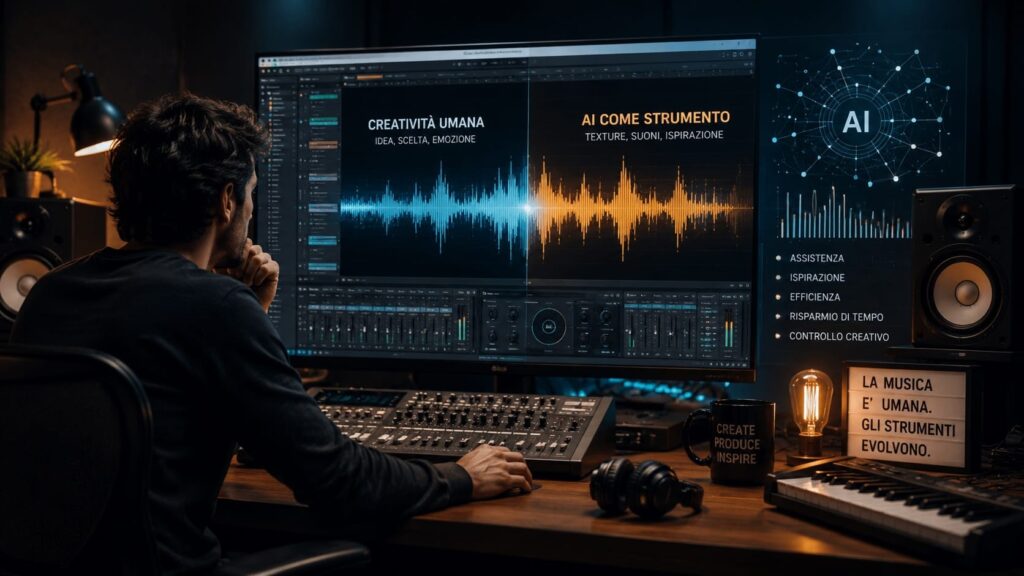
There is one thing that is becoming increasingly difficult for people making music today: explaining how a song was made without being immediately judged.
You use artificial intelligence? Fine, you’ve already lost, but perhaps the problem is that we are putting completely different situations into the same box.
Generating Is One Thing. Creating Is Another.
An artist can write a melody, arrange, produce, record, mix, edit, choose sounds and then use AI for a small part of the process. A layer, a texture, a rhythm, a sound that would otherwise have required hours of research or the involvement of a musician, an arranger or a studio. That part can then be cut, modified, processed, incorporated into a much larger arrangement and become just a small element of a work created by a person.
And yet today, all it takes is for a system to detect a characteristic that can be traced back to AI for that production to be viewed with suspicion and excluded.
The Cost Problem
Let’s take a very simple example: an independent producer wants to create a song, they don’t have a major label behind them and they don’t have the ability to invest thousands of euros in a single production. They cannot afford an orchestra, ten session musicians, a sound designer and weeks of production. But they do have ideas, experience (perhaps thirty years of it), taste and something to say.
If a technology allows them to reduce some costs and turn an idea into something concrete, why should they automatically be considered less of an artist?
The cost of a tool does not measure the value of the creativity of the person using it.
It has always been this way in music, because the synthesizer did not kill the musician, the sampler did not eliminate the composer, and the computer did not erase the producer. Technology simply changed the way people work.
But Then Comes the Detector
And this is where the paradox begins.
AI detection systems cannot see your DAW session.
They don’t know how many hours you spent in front of your computer, they don’t see the tracks you recorded, they don’t know what changes you made, they don’t know how many times you rewrote an arrangement.
They analyze the audio and look for statistical characteristics associated with artificial generation. Scientific research is in fact highlighting how difficult it is to reliably distinguish between human-made music, AI-generated music and hybrid music, and this can lead to something absurd:
a producer who has invested time, money and creativity can be placed in the same category as someone who generates hundreds of tracks automatically and uploads them online with virtually no creative intervention.
These are two completely different phenomena.
The Real Problem Isn’t AI
The problem is the lack of distinction.
At the very least, we should distinguish between:
Music entirely generated by AI
and
Music created by a human using AI tools.
They are not the same thing and, above all, they should not be treated as the same thing when it comes to artistic evaluation. Even institutions dealing with copyright protection are trying to distinguish AI as a tool for assistance from AI replacing human creativity.
In the End, One Thing Still Matters
A machine can generate a sound, it can generate a thousand sounds and it can even generate a song, but the decision of what to keep, what to remove, how to arrange it, how to tell a story and why to do it remains a creative act.
Perhaps we should stop asking only:
“How much AI is in this music?”
And start asking:
“How much of the artist is in this music?”
Because using a tool to produce something you otherwise could not afford does not necessarily mean you have stopped being an artist. Sometimes it simply means that you are looking for a way to keep making music.
And today, for many independent musicians, that is far from a minor distinction.